
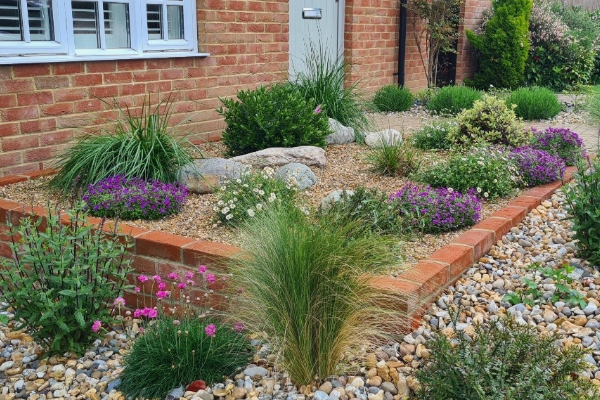
Designing Gardens for Hotter, Drier Summers: What Needs to Change?
21 August 2026
Sustainable garden design has traditionally focused on creating wildlife-friendly spaces, reducing unnecessary resources and working naturally with the landscape. But as hot, dry Summers become more challenging, another consideration is becoming increasingly important: how will a garden cope with changing weather conditions?
For homeowners in Kent and across the South East, this isn't simply a question of choosing a few drought-tolerant plants. A resilient garden needs to consider planting, soil, lawns, water use, drainage and long-term maintenance as a whole.
In brief: what is a climate-resilient garden?
A climate-resilient garden is designed to cope with changing and unpredictable weather. It may include drought-tolerant planting, healthy soil, reduced lawn areas, rainwater harvesting, efficient irrigation and plants suited to the specific conditions of the site.
It doesn't mean creating a dry, Mediterranean-style garden. Instead, it's about choosing the right plants and design solutions for the conditions your garden actually experiences, while reducing the water and intervention it needs.
Five things to consider in a climate-resilient garden
- Choose plants for the conditions, not simply appearance. “Right plant, right place” is increasingly important.
- Look after the soil. Good soil management supports plants during dry periods and can improve conditions during wetter weather.
- Rethink the lawn. An established lawn can tolerate dry conditions, while reducing unnecessary lawn areas can reduce water demand.
- Use water intelligently. Rainwater harvesting and efficient irrigation can reduce reliance on mains water.
- Design for extremes. Gardens need to cope with dry Summers as well as wet Winters and periods of heavy rainfall.
Why garden design needs to respond to hotter Summers
The UK has always had changeable weather, but recent Summers have made it harder to rely on traditional assumptions about how a garden will perform.
The effects are increasingly visible in our gardens. Plants become stressed during prolonged dry periods, lawns turn brown, soil dries out and newly planted borders can require frequent watering.
This doesn't mean every garden needs to become a “drought garden”. It does mean that water availability and resilience should increasingly be part of the design conversation. The question isn't simply “What will look good?” but also “What will thrive here?”
Right plant, right place matters more than ever
One of the most important principles of good garden design has always been choosing the right plant for the right place. As conditions become more challenging, that principle becomes even more important.
A sunny, free-draining border presents very different conditions from heavy soil that remains wet through Winter. A sheltered courtyard can behave differently again, with surrounding walls creating a hotter microclimate.
This is why simply choosing from a list of drought-tolerant plants isn't necessarily the best approach. A plant may tolerate dry conditions but struggle in heavy, wet soil. Another may cope with Winter moisture but suffer in a hot, exposed border.
Good planting design starts with understanding the site: its soil, drainage, aspect, exposure and how conditions change throughout the year.
Where appropriate, plants such as lavender, Achillea and Stipa can work well in drier conditions for instance, while plants such as Cornus, Astilbe and Zantedeschia are better suited to wetter soils.
The aim is to create planting that is naturally suited to its conditions, reducing the need for constant intervention.
Healthy soil is part of the solution
It's easy to concentrate on what's growing above ground and overlook the importance of the soil beneath it.
Good husbandry, including feeding and adding organic matter where appropriate, can help support healthy plant growth and improve soil condition. This matters during dry weather but can also help gardens deal with wetter periods.
This is particularly relevant in parts of Kent where heavier soils can become hard and dry in Summer but slow to drain in Winter.
Depending on the garden, improving soil structure, addressing drainage or using raised and mounded beds can all help create better growing conditions.
Does the garden need as much lawn?
The traditional British lawn is another element worth reconsidering. An established lawn doesn't necessarily need to remain green throughout a hot, dry summer. Grass can naturally go dormant, turning brown while protecting its roots, and recover when cooler, wetter conditions return.
For some gardens, retaining a lawn is absolutely the right decision. It may provide space for children, entertaining, recreation or simply enjoying an open area of garden.
For others, reducing the amount of lawn could create opportunities for planting, seating or other features while reducing water and maintenance requirements.
The important question is not whether lawns are good or bad, but whether the amount of lawn is right for the way the garden is used, which the second article in our Drought-Tolerant Garden Series considers.
Saving water starts with capturing it
Rainwater harvesting is a straightforward way of making better use of water when it is available. Solutions range from water butts through to larger underground rainwater harvesting tanks. For a new garden, these can be considered as part of the design rather than added as an afterthought.
Stored rainwater can then be used during dry periods, potentially reducing reliance on mains water. The principle is simple: Rather than asking only how much water a garden needs, consider how much water it can capture and reuse.
Irrigation should be efficient
Good planting and soil management can reduce the need for irrigation, but there are situations where an irrigation system is a sensible part of garden design.
Traditional sprinklers and liberal hosepipe watering can be wasteful. Timer-controlled drip irrigation is much more targeted, delivering water where it is needed and using less than conventional methods.
For larger or more complex gardens, irrigation is best considered alongside the planting scheme rather than added afterwards. Professional specification and installation can also help ensure the system is appropriate for the garden. This is particularly relevant as Temporary Use Bans and hosepipe restrictions become an increasingly familiar part of gardening in the South East.
The aim should be to create a garden that needs less water in the first place, with efficient irrigation providing support where it is genuinely required.
Don't forget to mulch!
Mulching is another simple way to help manage water. A layer of suitable material over the soil surface reduces evaporation and suppresses weeds, helping the soil retain moisture for longer.
The choice of mulch can also complement the garden's design. Bark mulch can work naturally within informal or rural planting, while pebbles, cobbles or shingle can suit more contemporary gardens. It's a good example of how practical and aesthetic considerations can work together.
Design for drought – but don't forget Winter
Perhaps the biggest mistake would be to think about climate-resilient garden design as simply designing for drought. Gardens increasingly need to cope with both extremes: prolonged dry periods in Summer and wet Winters or periods of heavy rainfall with potential flooding or water logging – another garden challenge we’re seeing more of across the South of England.
A planting scheme selected purely for drought tolerance may not perform well if the soil becomes saturated for long periods. This is why garden design needs to consider seasonal conditions rather than individual weather events.
For some sites, that might mean raised or mounded planting areas. For others, it could mean improving drainage or choosing plants adapted to heavier soils. The right solution will always depend on the individual garden.
What does a climate-resilient garden look like?
It doesn't have to look radically different from a beautiful, traditionally designed garden. It can still include lawns, colourful borders, trees, shrubs, terraces and spaces for entertaining. The difference is in how those elements are selected and brought together.
Planting is suited to the site. Soil is properly prepared. Water is captured where possible. Irrigation is used efficiently when needed. Lawn areas reflect how the garden is actually used.
The result can be a garden that is better equipped to cope with hotter, drier Summers while remaining attractive, practical and easier to manage over the long term.
Designing gardens for the future
A drought-tolerant garden shouldn't be seen as a response to one particularly hot Summer. It's part of a wider shift in how we think about garden design – and it’s a conversation we’re increasingly having with our clients who are thinking about the future of their outside space.
A new garden is a long-term investment. It needs to continue working for many years, which means considering the conditions it will experience throughout its life.
For homeowners in Canterbury, across Kent and throughout the South East, that increasingly means considering water, soil, planting and drainage alongside the more familiar questions of style, layout and how the garden will be used.
Climate-resilient garden design isn't about predicting exactly what the weather will do next year. It's about making sensible design decisions now that give a garden the best chance of thriving in whatever conditions come next.
New Series: Drought Tolerant Gardens
This article is the first in our new series of articles: Drought-Tolerant Gardens. Once you have established a water-wise strategy for your wider garden, it’s time to take a closer look at your turf. Is keeping a vast, thirsty lawn still practical for your lifestyle?
Part 2 in our series asks: Does Your Garden Need a Lawn? Rethinking Grass in a Changing Climate, and we explore how right-sizing turf areas, understanding lawn recovery, and introducing resilient alternatives can transform your outdoor space.
How will your garden look in the future?
At Haywood Landscapes, we've been designing and building gardens across Kent for more than 30 years. Our approach brings garden design, planting, landscaping and construction together, allowing the practical requirements of a site to be considered alongside the way you want your garden to look and feel.
If you're considering a new garden in Canterbury, Kent or the surrounding area and want to create a space that is beautiful, practical and designed with the future in mind, we'd be happy to talk through your ideas.
Contact us here or call us on 01227 733447 to learn more about our garden design and build services.