
The Right Plant in the Right Place: Why Planting Choice Matters More as Summers Get Drier
27 October 2026
A successful, climate-resilient garden relies on more than simply choosing drought-tolerant species. True sustainability requires a technical understanding of your plot's soil mechanics, drainage behaviour, sun exposure, and local microclimates. Selecting plants that match these intersecting conditions ensures your landscape thrives through both baked Summer droughts and heavy Winter saturation.
Key Takeaways for Drought Tolerant Planting Schemes
- A plant that thrives in bone-dry Summer conditions will frequently fail if the ground becomes waterlogged or structurally compacted during Kent’s wet Winter months.
- Factors like aspect, wind exposure, and surrounding architectural heat sinks radically alter moisture levels, demanding bespoke, site-specific planting choices rather than generic templates.
- Partnering with experts ensures that soil type, seasonal drainage, and plant selection are engineered as a cohesive, long-term system.
When planning a resilient outdoor space, ‘the right plant in the right place’ is one of the most frequently repeated phrases in horticulture. However, as our Summers grow hotter and drier - and our Winters increasingly unpredictable - that golden rule requires a much deeper, more technical approach.
In our previous explorations into managing Summer-ready landscapes, we looked at Designing Gardens for Hotter, Drier Summers and evaluated whether Does Your Garden Need a Lawn? Rethinking Grass in a Changing Climate. As the 3rd article in our new series, we are turning our focus to the soil and site mechanics that dictate whether a planting scheme truly succeeds or quietly fails beneath the surface.
Avoid the trap of simply buying a generic list of drought-tolerant plants. Professional drought tolerant garden design requires looking at how a complex web of environmental variables interacts across your entire plot.
Beyond the Label: The Winter Waterlogging Trap
One of the most common pitfalls we see in domestic gardens is assuming that a plant adapted to dry conditions can be planted anywhere. The reality of Kent's diverse geology - from the dense Wealden and London clays of the lowlands to the flinty chalk of the North Downs - introduces a hidden challenge.
A soil that bakes rock-hard and cracks during July and August can easily transform into a waterlogged, oxygen-starved bog by January.
The Dry-Soil Specialists
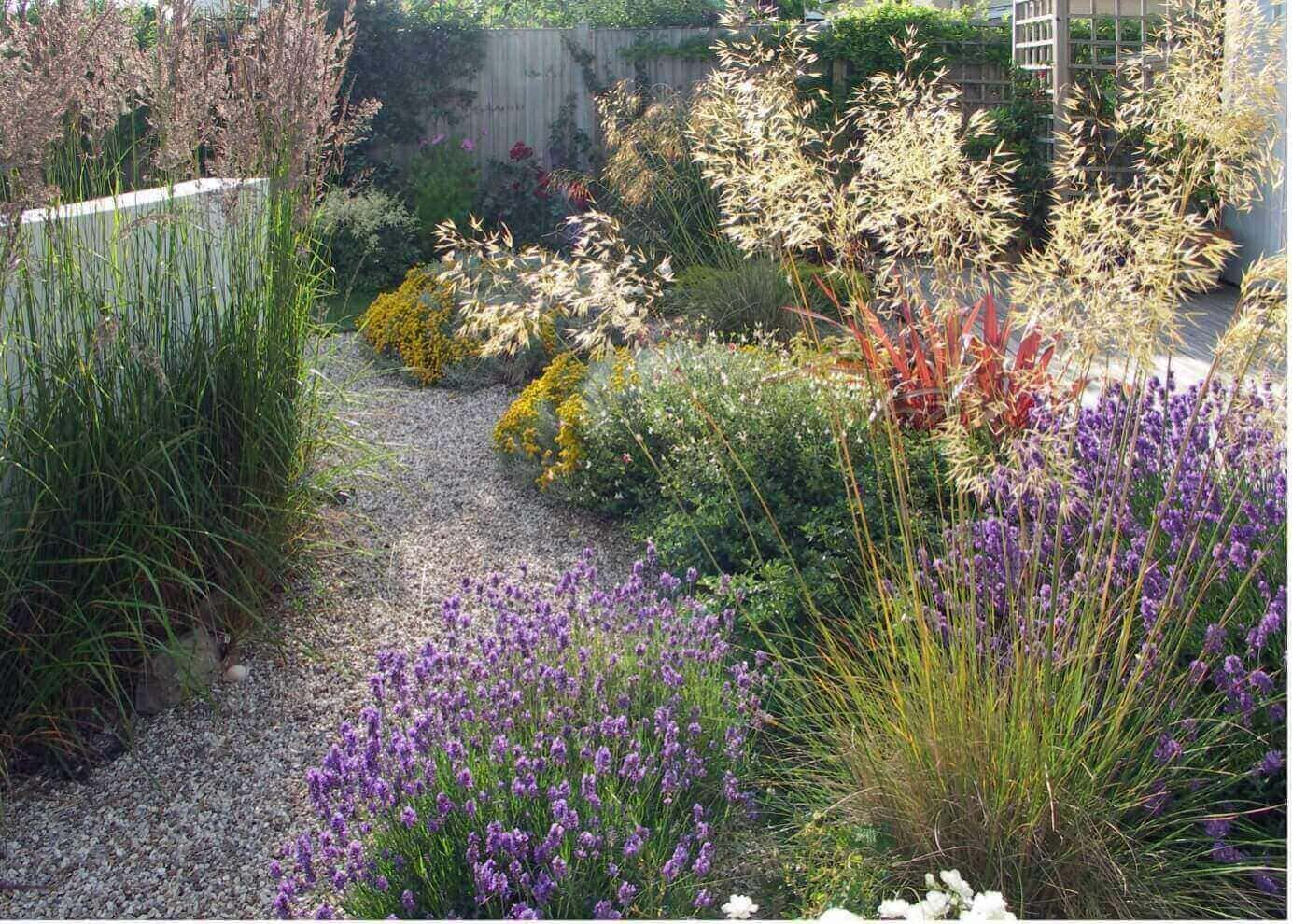
Plants like Lavandula (lavender), Achillea, and Stipa tenuissima excel in free-draining, lean soils where their roots can breathe. If planted in heavy, poorly drained clay that stays saturated through winter, their roots will succumb to rot.
The Wet-Soil Tolerators
Conversely, plants that love moisture - such as Hydrangea, Astilbe, and Zantedeschia (calla lilies) - will wither or scorch if forced to endure a parched, unamended south-facing slope during a summer heatwave.
True sustainability means evaluating how your soil behaves across all twelve months of the year, not just when the sun is shining.
Key Environmental Factors in Professional Planting Selection
When our design team specifies bespoke drought tolerant planting schemes, we look far beyond visual aesthetics. Every successful border balances a comprehensive site audit:
1. Soil Type and Structure
Whether your garden sits on heavy clay, sandy loam, or sharply drained chalk dictates how water moves and stores underground. Clay holds moisture tightly but bakes hard; sandy soil drains instantly but leaches nutrients. Understanding this structure is vital for establishing a climate resilient garden.
2. Drainage and Subsurface Behaviour
Surface puddles are often symptoms of an impermeable subsoil. Before introducing any new planting, ensuring the earth can shed excess Winter moisture prevents root suffocation and structural shift.
3. Aspect and Sun Exposure
South- and west-facing boundaries absorb intense solar radiation, creating high-evaporation zones. North- and east-facing borders remain cool and damp, requiring completely different botanical palettes.
4. Microclimates and Seasonal Conditions
A courtyard enclosed by brick walls creates a localised heat sink, while exposed boundaries suffer from drying winds that strip moisture from foliage overnight - even when ambient temperatures are moderate.
Crafting a Balanced Landscape for Kent Homes
Achieving a garden that looks lush and established while requiring minimal irrigation is an exercise in ecological engineering. By matching structural shrubs, ornamental grasses, and perennial matrices to their exact environmental niche, you eliminate the cycle of constant plant replacement and intensive watering.
Whether you are looking to rework a sun-baked terrace border or planning a complete Kentish garden design project from the ground up, professional planning ensures your investment handles whatever the British weather brings.
Let Us Help You Shape Your Outdoor Space
From initial soil analysis to the final placement of structural planting, expert guidance ensures your garden is built to last.
Explore our professional planting schemes page to see how we bring living spaces to life, or browse our sustainable gardens articles for more practical inspiration.
Ready to create a beautiful, resilient landscape tailored to your property? Contact our Canterbury team today or call us on 01227 733447 to arrange your design consultation with Haywood Landscapes.